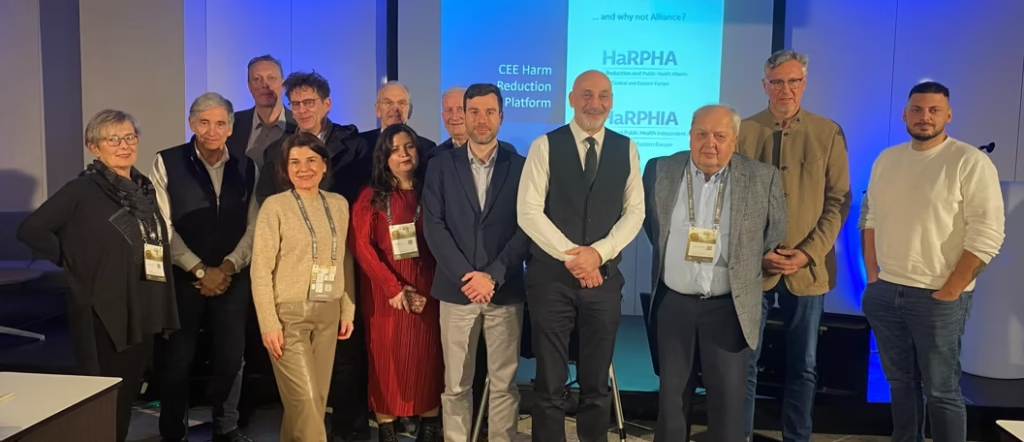

The interdisciplinary panel of experts at PragueONCO 2025 agreed that harm reduction represents an important tool in the prevention of malignant tumours. The discussion resulted in a memorandum confirming broad expert consensus on the need to minimise harm where complete elimination of risky behaviour is not possible.
On the possibilities of reducing the harm of risky behaviour in oncological prevention
On 31 January, an interdisciplinary discussion meeting focused on the concept of harm reduction in oncological prevention took place as part of the PragueONCO colloquium. The meeting was held at the invitation of Prof. MUDr. Luboš Petruželka, CSc., and Doc. MUDr. Jiří Votruba, Ph.D., and brought together experts from various areas of medicine, public health and related fields. Harm reduction as an approach is not new, but its importance in the prevention of malignant tumours has begun to be appreciated more significantly in recent years.
The introductory lecture was delivered by Prof. David Khayat, Emeritus Head of the Oncology Department at Pitié Salpêtrière in Paris and former President of the French National Cancer Institute. He emphasised that most oncological diseases in adults are the result of exposure to carcinogens, with the risk depending on the dose and duration of exposure. However, the complete elimination of risky behaviour is difficult, and historical prohibition models have proven ineffective.
The concept of harm reduction is based on the assumption that certain risky behaviour is part of human nature. The aim is therefore not absolute elimination, but the minimisation of harm. This approach developed particularly in the 1980s in connection with HIV/AIDS, for example through needle exchange programmes or substitution treatment.
Tobacco use is also an important area for the application of harm reduction. For smokers who cannot or do not want to stop smoking, innovative smokeless tobacco and nicotine products in particular represent an opportunity, as they do not involve tobacco combustion and are associated with significantly lower exposure to harmful substances. An example is Sweden, where openness towards these products has led to a decline in smoking prevalence below 5% and to the lowest incidence of smoking-related tumours in Europe.
The following memorandum represents a key outcome of the discussion and confirms broad expert consensus that harm reduction should be part of the primary prevention of malignant tumours.
MEMORANDUM
from the expert discussion forum
The concept of “harm reduction” as part of primary prevention amid the increasing incidence of malignant tumours
Discussion forum held on 31 January 2025 on the occasion of the 16th Prague interdisciplinary colloquium PragueONCO
Motto:
Complete elimination of risk factors is not always possible; harm minimisation is a way to reduce risks through practical and accessible methods.
Introduction
Harm reduction is a preventive strategy that focuses on minimising risk factors contributing to the development of cancer, because the complete removal of risk is not always possible. Cancer is one of the diseases of civilisation.
The aim of the harm reduction approach is to reduce the overall harm caused by an unhealthy lifestyle, environmental factors and exposures that are known to increase the likelihood of developing cancer. It involves reducing risks through practical, innovative and accessible methods for which there is scientific evidence of improved overall health outcomes.
Areas with the greatest benefit from applying the concept of harm reduction
At least nine areas have been identified in which the application of this concept appears to be particularly beneficial:
- Tobacco smoking
- Nutrition and weight management
- Physical activity
- Protection against UV radiation
- Vaccination
- Screening and early detection of disease
- Exposure to environmental factors and occupational safety
- Exposure to chemicals and pesticides
- Genetic counselling and testing
Discussion of point 1: Tobacco smoking
It was stated that:
- Smoking is globally and in the long term the leading cause of oncological diseases. It has been proven to contribute to the development of lung cancer, oral cavity cancer, laryngeal cancer, bladder cancer and more than a dozen other types of tumours.
- Nicotine is a highly addictive substance causing dependence on smoking, but according to current scientific knowledge it is not carcinogenic. The risk factor is exposure to substances produced by the burning of tobacco.
- The most effective prevention is not to start smoking, or to stop smoking completely. Every smoker should be offered participation in a smoking cessation programme in primary care, including counselling and support.
The harm reduction strategy in the area of tobacco use includes:
- nicotine replacement therapy, for example patches and chewing gum, and other treatment supporting smoking cessation,
- the inclusion of innovative smokeless forms of tobacco/nicotine use in the cessation process.
Available scientific evidence shows a significant reduction in the content of harmful substances in innovative smokeless products, which:
- reduce the individual health risk associated with smoking and passive smoking,
- contribute to reducing the prevalence of smoking in society.
The inclusion of innovative alternatives, such as e-cigarettes, heated tobacco, oral tobacco and nicotine pouches, in the concept of harm reduction is supported by international professional societies, for example the American Society of Clinical Oncology and the Royal College of Physicians.
The U.S. Food and Drug Administration (FDA) has granted heated tobacco and oral snus tobacco the status of modified-risk products.
In the Czech Republic, the potential of the harm reduction strategy in the area of tobacco/nicotine is not fully used. The main obstacle is the politicisation of the issue, low awareness among physicians and the absence of a unified expert approach. It is therefore desirable to ensure:
- the inclusion of the concept of harm reduction in tobacco control strategy,
- systematic education of physicians and the public,
- the anchoring of the approach in expert recommendations.
It is not purposeful to wait decades for the results of extensive epidemiological studies if the evidence available today already shows a reduction in exposure to harmful substances compared with cigarette smoke by 95% or more.
The issue of innovative products was already included in the recommendations of the Society of General Practice of the Czech Medical Association of J. E. Purkyně in 2022.
Discussion of point 2: Nutrition and weight management
It was stated that:
- Obesity increases the risk of developing breast cancer, colon cancer and endometrial cancer. According to the WHO, by 2035 it will become the leading cause of oncological diseases and will overtake smoking.
- Processed and ultra-processed foods and red meat are associated mainly with colorectal cancer.
- Alcohol is linked to the risk of breast cancer, liver cancer, pancreatic cancer and oral cavity cancer.
The harm reduction strategy includes:
- consumption of a diet rich in fruit, vegetables, wholegrain products and lean proteins,
- maintaining a healthy body weight and sufficient physical activity,
- the use of innovative approaches, such as bariatric surgery and GLP-1 agonists,
- control not only of the quantity but also the quality of the diet.
It was pointed out that in France, after the transition to mass-imported meals in schools, there was an increase in colorectal cancer among the population under 40 years of age.
Further conclusions of the discussion
- Oncological risk accumulates over the course of life and individual risk factors potentiate one another.
- The concept of harm reduction should be applied across areas, not in isolation.
The discussion was not concluded and interdisciplinary talks will continue with the participation of additional experts.
Chairs:
Prof. MUDr. Luboš Petruželka, CSc.
Doc. MUDr. Jiří Votruba, Ph.D.
Panel participants:
MUDr. Jozef Čupka, MPH; JUDr. Rostislav Dvořák; Prof. Ing. Jana Hajšlová, CSc.; Prof. MUDr. Tomáš Hanuš, DrSc.;
Prof. David Khayat, MD, PhD., FASCO; Mgr. Lilly Ahou Koffi, MBA; Doc. MUDr. Viktor Mravčík, Ph.D.; Prof. MUDr. Štěpán Svačina, DrSc.